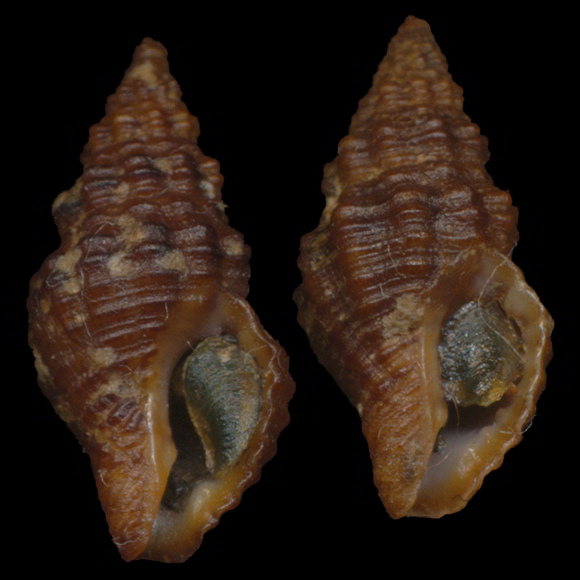
Predator in the rocky upper infralittoral.
Basionym: Buccinum dorbignyi.
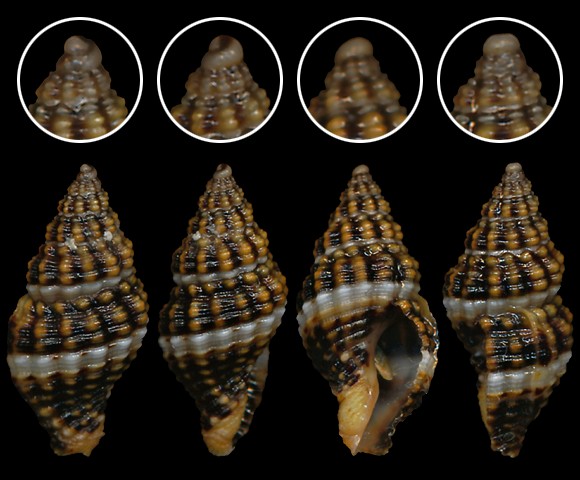
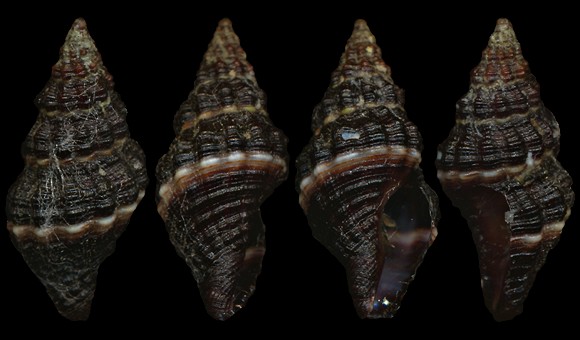
Above: crabbed specimens found on shallow rocks near the prehistoric harbour of Falasarna, W. Crete. 14-19mm.
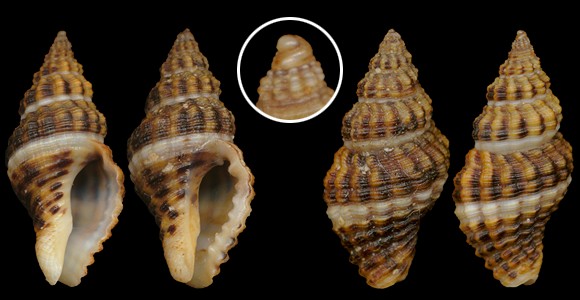
35-40m deep, in Alger bay, Algeria. 19,5mm.
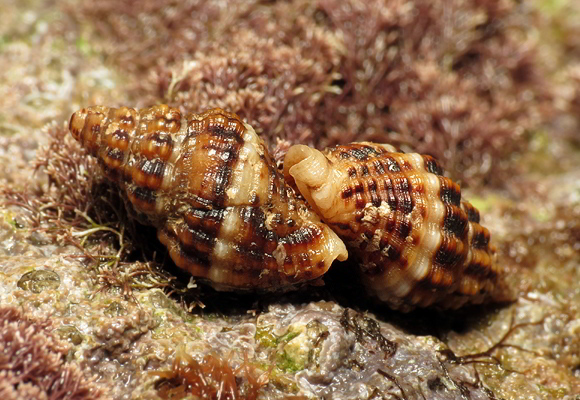
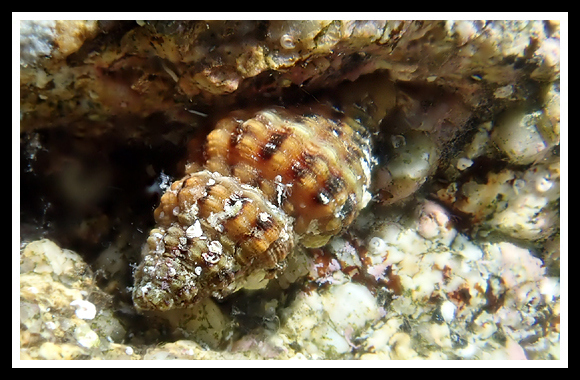
On the breakwater, Playa de la Almadraba, west of Dénia, Alicante Province, Comunidad Valenciana, SE. Spain. Original picture provided by K. Schulz for iNaturalist – (CC BY).
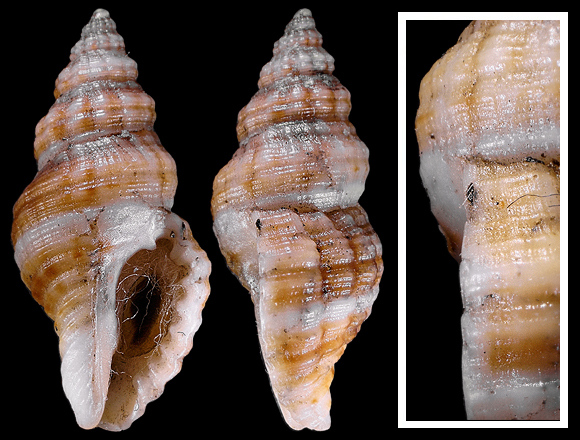
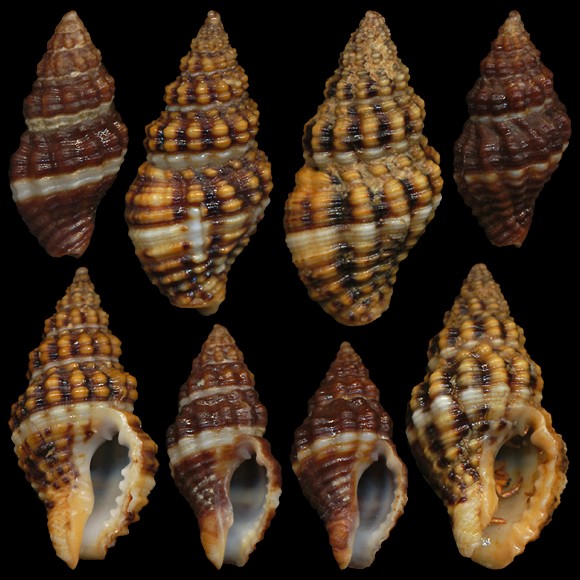
The pale spiral band and the two rows of nodules at the periphery are constant. The remaining (other nodules, background colour) can vary. – Above, an almost smooth shell, which can be related to dorbignyi, collected at 1m deep, under rock, Nebida, Carbonia-Iglesias, SW. Sardinia. 18mm.
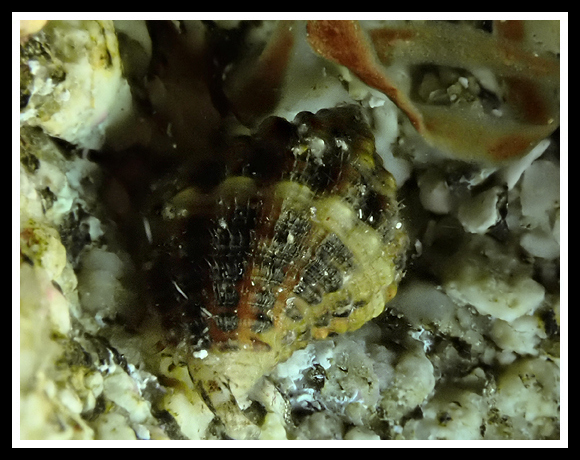
Ionian Sea to Eastern Mediterranean, Aegean. « The B. gaillardoti has some relationship with the B. Dorbignyi: its longitudinal costae are less elevated and therefore less knobby at the intersections of the transversal striae, which are of inequal strength; the aperture is larger, the canal shorter and less raised, the umbilical slit barely visible. Its colour is of a uniform red-brown; the aperture purple-brown, reddish on the edges. » – E. Puton: “Lettre au docteur Mougeot sur les Mollusques de Syrie”, Annales de la Société d’Émulation du Département des Vosges vol. IX (1), Épinal 1856, p.224-225.
Dark specimen collected on shallow reef at Ormos Point, north of Agios Nikolaos, Lasithi, N. Crete. 14mm.
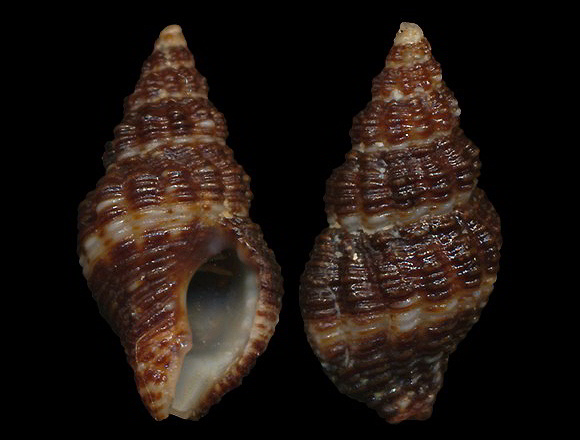
Dedicated to M. Gaillardot; « this is a tribute I am pleased to give him: the natural history of Syria, which owes so much to him, will confirm it. » – Ibid.
Under rocks, Ayía Nápa, Famagousta, E. Cyprus. 11mm.
« Aissaoui et al. (2016) did not designate a neotype for this taxon, as topotypical material from Lebanon was unavailable. Nevertheless, they applied this taxon name to specimens from Aegean Sea that do not fully conform to Puton’s original description. The Aegean material studied by Aissaoui et al. (2016) showed a very small shell, measuring 10–12mm in length, and a dark orange to black colouration, with dark brown to black axial interspaces and a white spiral band on the medial part of the spire. These features contrast sharply with Puton’s description of a uniformly brownish-reddish shell, 16mm in length, and lacking any spiral band. » – Nappo & Stahlschmidt: “Playing hide and seek: On the identity of Buccinum assimile Reeve, 1846, with a description of a new species”, Bollettino Malacologico vol. 62(1), Milano 2026, p.99.
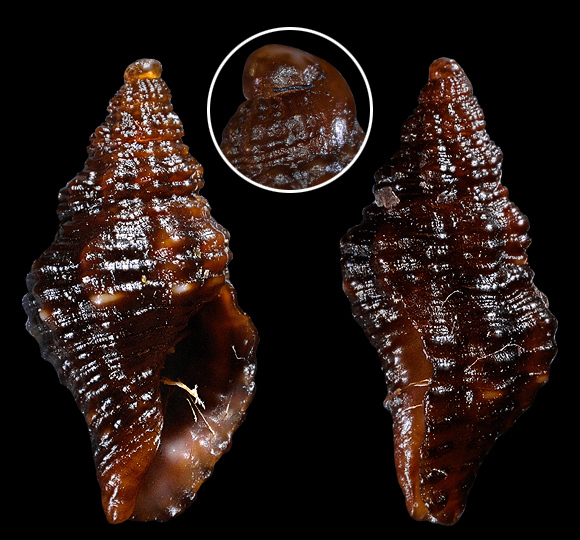
« On the other hand, these features are also present in typical Aplus coccineus (and its synonym Pollia campisii), which is characterized by a fully orange shell without a spiral band and an axial sculpture stronger than the spiral one. To resolve this issue, it might be preferable in future work to assess genetically topotypical material from the easternmost Levant basin corresponding to Puton’s and Pallary’s descriptions. In the meantime, it would probably be better to consider Aplus gaillardoti as a nomen dubium. » – Ibid.
A subadult from Dardanelles Strait: beach drift, Kepez, Çanakkale, SW. Marmara Region, NW. Turkey. 7,2mm.