Protonym: Pleurobranchus aurantiacus.
Possible synonym: elongatus Cantraine.
Predator in the sciaphile infralittoral, down to 35m deep. The colour and the size of the animal make it impossible to separate from Berthellina edwardsii; only the shell can lead to a quick identification. The latter is described by Vayssière as follows:
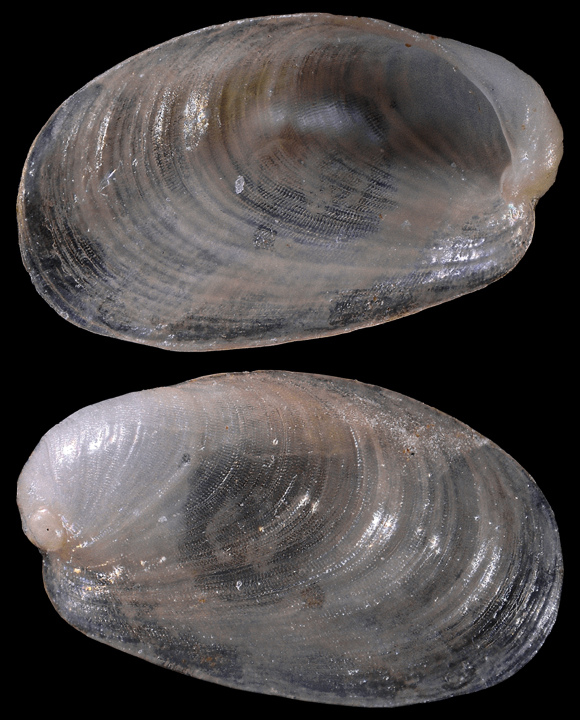
« It is solid, thick, therefore not very transparent, and offers little or no iridescence; it is more convex than that of the plumula and more auriculiform. Its colour is a matte amber yellow. Its concentric growth streaks are very visible to the naked eye; the spire is quite prominent and is made up of two and a half whorls: but this spire forms only a very small part of the entire shell, this being mainly constituted by the considerable expansion at the end of the last whorl. If we observe under a microscope the details of the ornamentation of this shell, we first notice that the strong concentric streaks which can be distinguished with the naked eye are separated from each other by weaker ones; then that the interval between two consecutive streaks offers a multitude of elongated and radiating nodules (compared to the turn which would be the starting point), closer together and thus more numerous than those of the shell of Pl. plumula. » – A. Vayssière: Recherches zoologiques et anatomiques sur les mollusques opistobranches du golfe de Marseille part. 1, Marseille 1885, p.117-118.
« It is solid, thick, therefore not very transparent, and offers little or no iridescence; it is more convex than that of the plumula and more auriculiform. Its colour is a matte amber yellow. Its concentric growth streaks are very visible to the naked eye; the spire is quite prominent and is made up of two and a half whorls: but this spire forms only a very small part of the entire shell, this being mainly constituted by the considerable expansion at the end of the last whorl. If we observe under a microscope the details of the ornamentation of this shell, we first notice that the strong concentric streaks which can be distinguished with the naked eye are separated from each other by weaker ones; then that the interval between two consecutive streaks offers a multitude of elongated and radiating nodules (compared to the turn which would be the starting point), closer together and thus more numerous than those of the shell of Pl. plumula. » – A. Vayssière: Recherches zoologiques et anatomiques sur les mollusques opistobranches du golfe de Marseille part. 1, Marseille 1885, p.117-118.
Above and below: 5m deep, under stones, Saronic Gulf, SE. Greece. 4,43mm.
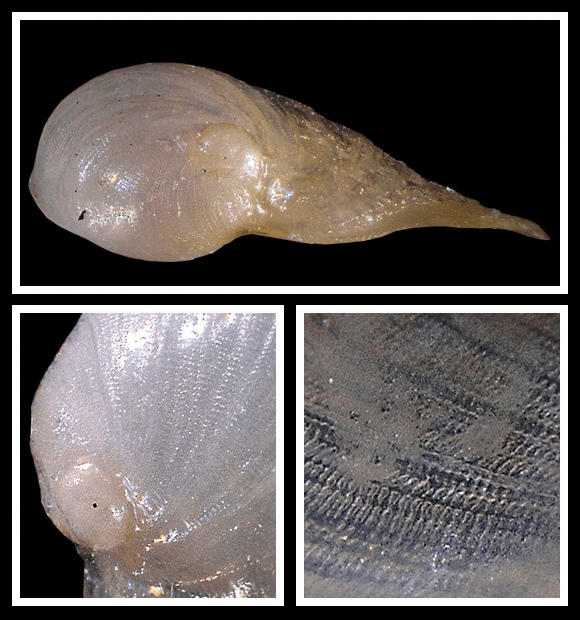
« This shell showed us no trace of cuticle, or at least it must adhere entirely to the calcareous substance. Of all the species of Pleurobranchus, it is almost the only one whose shell occupies almost the entire extent of the mantle, as Risso had very well observed; it is, in proportion to the dimensions of the animal, the largest and therefore effectively protects the entire visceral mass, which the shells of other species are far from doing. » – Ibid.