In A. Kermiche’s collection.
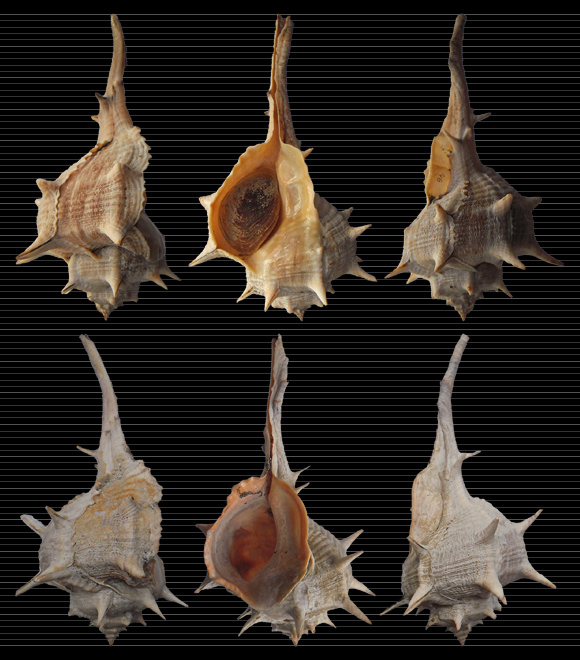
The specimens displayed here come from Jijel area (NE. Algeria), and Mostaganem (NW. Algeria). By their sizes, they belong obviously to the Alborán Group. Above: two large specimens, typical of the population. 97-99mm. Original pictures provided by A. Kermiche (DZ) – (CC BY-NC-SA).
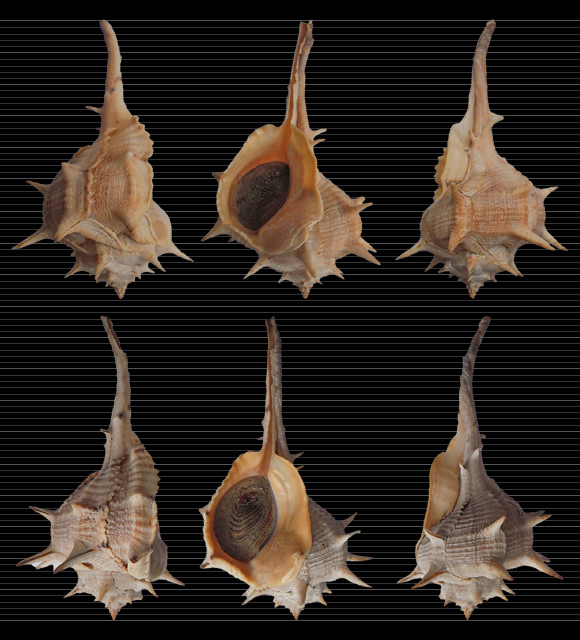
Original pictures provided by A. Kermiche (DZ).
– (CC BY-NC-SA) –
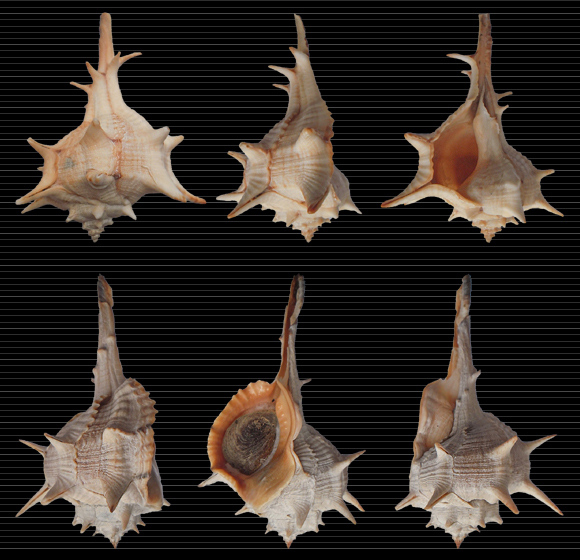
Original pictures provided by A. Kermiche (DZ).
– (CC BY-NC-SA) –
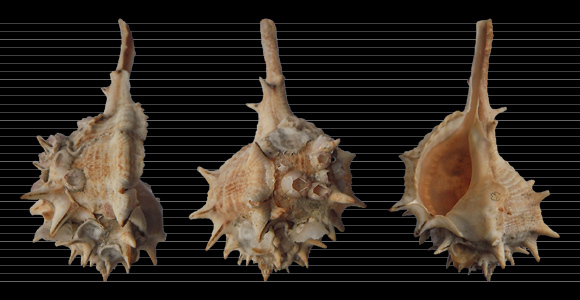
« Scales and spines are formed periodically during shell growth through a gradual and temporary projection of the mantle edge […]. This mantle projection is narrow, approximately matching the width of the future scale or spine. Its length increases slowly and continuously until the structure reaches its final length […], while carbonate layers are constantly secreted and deposited. At the apogee of the scale or spine formation process, the expanded mantle portion becomes nearly as long as the developing structure, resembling an internal mold of the scale or spine […]. » – L. R. Lopes de Simone: “Scales, spines and hairs in molluscan shells”, Malacopedia vol. 9(3), São Paulo 2026, p.21-23.
A “multispinosus”. 65mm.
Original pictures provided by A. Kermiche (DZ).
– (CC BY-NC-SA) –
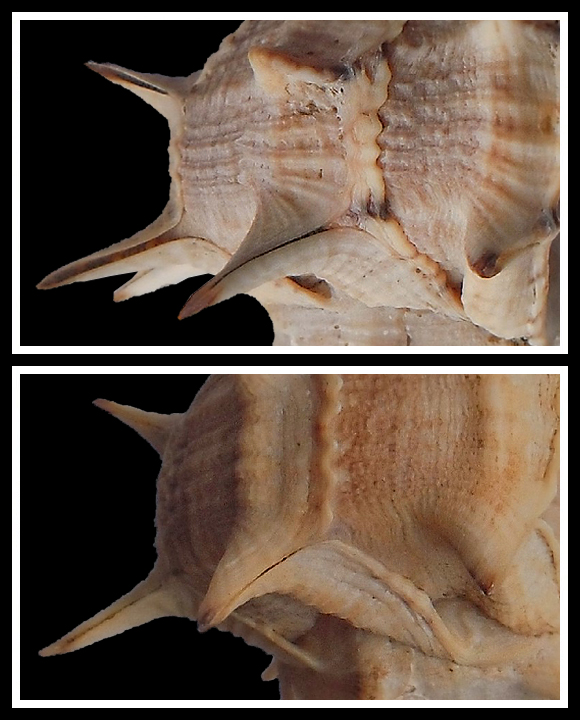
« In scales, the process ends once the structure has attained its required thickness […]. The mantle projection then gradually decreases and is reabsorbed into the mantle edge, usually disappearing completely […]. In spines, however, calcareous layers continue to be secreted until the two calcareous edges meet […]. During reabsorption, the mantle projection continues secreting calcareous material, thereby reinforcing the spine down to its base and leaving a longitu-dinal scar, the spine furrow […]. The mantle projection is subsequently reabsorbed […] and later reappears during the next cycle of spine formation. » – Ibid.
The next page is dedicated to the only other extant Bolinus species: B. cornutus (Linnaeus, 1758).