Scuderi, Reitano & Villari, 2025
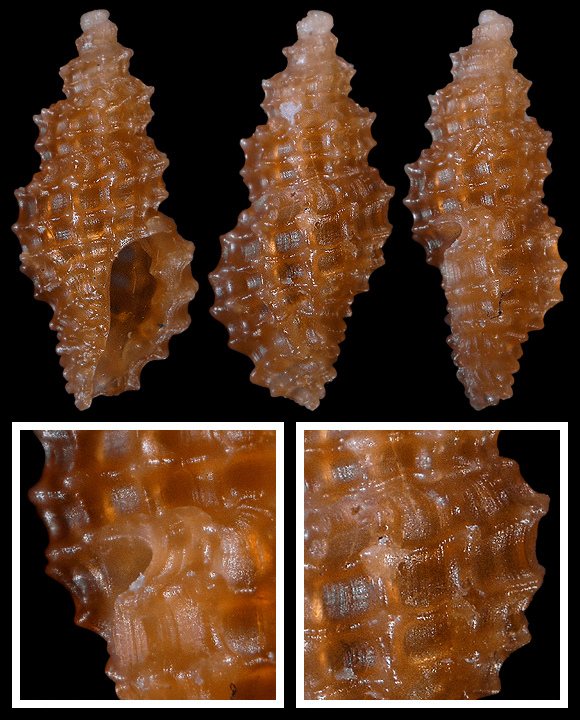
The shell of this species differs from that of granum but the following characters: « smaller dimensions, stouter profile with more delicate sculpture, pointed tubercles and unifmr chrestnut colour […] Compared to C. fatamorganae n. sp. it differs for: smaller dimensions, a stouter shell profile with deeper incised suture, wider aperture with more marked anal sinus and denticles on the inner lip; tubercles on the ribs are smaller and pointed, with PCI [primary cord I] smaller than others and close to suture. » – Scuderi, Reitano & Villari: “Two new species of the genus Clathromangelia Monterosato, 1884 (Gastropoda Raphitomidae) from the Mediterranean Sea, with lectotype designation of C. granum (R.A. Philippi, 1844)”, Biodiversity Journal vol. 16(1), Palermo 2025, p.114.
Above and below: a specimen collected at 40m deep, landing ship tank shipwreck, isola di Ponza, Pontine archipelago, west of Lazio region, SW. Italy. 3,3mm.
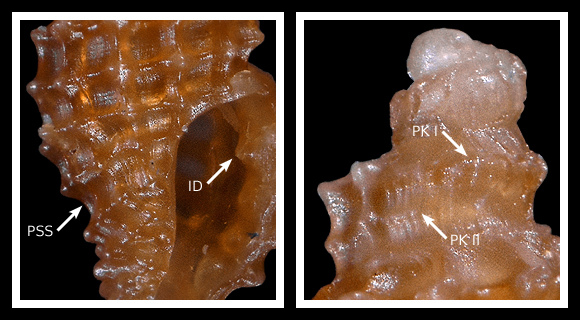
« The PSS [space between the last primary cord and the first one of the siphonal fasciole] is almost of the same width as interspaces and fasciolae are not so strong [than in granum]. Inner lip with less marked denticles. The conical protoconch has more robust and clearly prosocline axial ribs and bears one single (upper) carina just before the protoconchteleoconch boundary. » – Ibid. In fact, as it can be seen on SEM images in Scuderi’s article and also on this picture, the upper carina (PK I), which is well marked, is followed downstream by a very weak PK II, while PK II is much more visible in granum or fatamorganae.
« Protoconch sculpture is a relevant useful item for identification of similar species of Clathromangelia […] In particular, the presence and number of spiral cords on the last portion, just before the PTT [protoconch - teleoconch transition], combined with the axial micro sculpture present on the nucleus and earlier whorls, is diagnostic and is a species-specific character. »
« Protoconch sculpture is a relevant useful item for identification of similar species of Clathromangelia […] In particular, the presence and number of spiral cords on the last portion, just before the PTT [protoconch - teleoconch transition], combined with the axial micro sculpture present on the nucleus and earlier whorls, is diagnostic and is a species-specific character. »