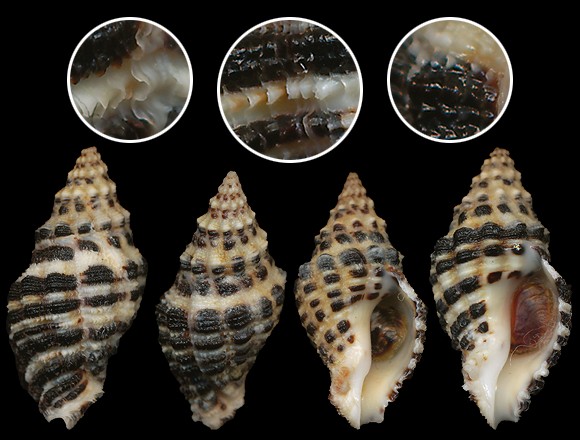
Gulf of Aden, Red Sea. Introduced in eastern mediterranean: Mersin 1995, Cyprus 1997, Crete 2008, Anatoliki Makedonia 2013… Predator on mussels in rocky bottoms of the shallow infralittoral. Recorded as corallivorous in the Persian Gulf (2007, in Saledhoust & al., 2011) but this could result from a confusion with E. martensi Schepman 1892: formerly known as Morula martensi Dall 1923, the species was indeed often confused with the martensi of Schepman.
Shell « slender, lanceolate, heavy, nodose. Shoulder weakly sloping, concave. White or creamy white with dark brown or blackish colored primary spiral cords and occasionally scondary cords 2 or 3. Aperture glossy white. Spire very high with 3,5 protoconch whorls and teleoconch up to 7 weakly convex, strongly shouldered, nodose whorls. Suture adpressed. Protoconch small, conical, acute; terminal lip raised, of sinusigeral type. Axial sculpture of teleoconch whorls consisting of high, strong, broad, nodose ribs and erratically placed strong varices. Last teleoconch whorl with 8-11 ribs, occasionally with one or two errratically placed, broad varices. Spiral sculpture of high, strong, nodose and squamose primary, secondary and tertiary cords. […] Aperture large, narrow, ovate; columellar lip smooth, entirely adherent, with low parietal tooth at adapical extremity; anal notch deep, borad; outer lip weakly erect, […] denticles elongate within aperture. Siphonal canal short, broad, dorsally recurved, broadly open. » – R. Houart: “Rehabilitation of Ergalatax martensi…” The Nautilus 122(2) 2008, p.102-105.
Shell « slender, lanceolate, heavy, nodose. Shoulder weakly sloping, concave. White or creamy white with dark brown or blackish colored primary spiral cords and occasionally scondary cords 2 or 3. Aperture glossy white. Spire very high with 3,5 protoconch whorls and teleoconch up to 7 weakly convex, strongly shouldered, nodose whorls. Suture adpressed. Protoconch small, conical, acute; terminal lip raised, of sinusigeral type. Axial sculpture of teleoconch whorls consisting of high, strong, broad, nodose ribs and erratically placed strong varices. Last teleoconch whorl with 8-11 ribs, occasionally with one or two errratically placed, broad varices. Spiral sculpture of high, strong, nodose and squamose primary, secondary and tertiary cords. […] Aperture large, narrow, ovate; columellar lip smooth, entirely adherent, with low parietal tooth at adapical extremity; anal notch deep, borad; outer lip weakly erect, […] denticles elongate within aperture. Siphonal canal short, broad, dorsally recurved, broadly open. » – R. Houart: “Rehabilitation of Ergalatax martensi…” The Nautilus 122(2) 2008, p.102-105.
On stones, Shikmona beach, Haifa, NW. Israel, december 2007. 24-25mm.
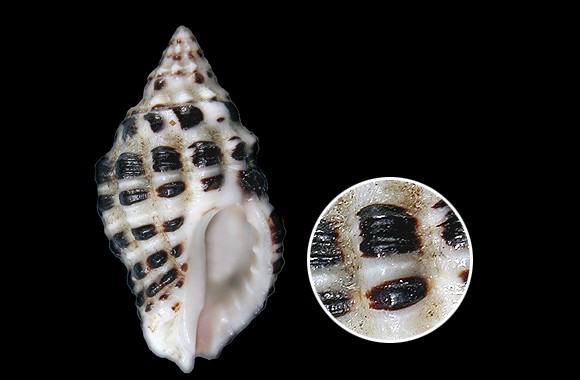
« This species is named in honor of Mrs. Marie-Louise Buyle-Junion (1916-2003), former librarian of the Belgian Malacological Society. She was one of the mainstays of the Society, together with her husband, Jean Buyle. »
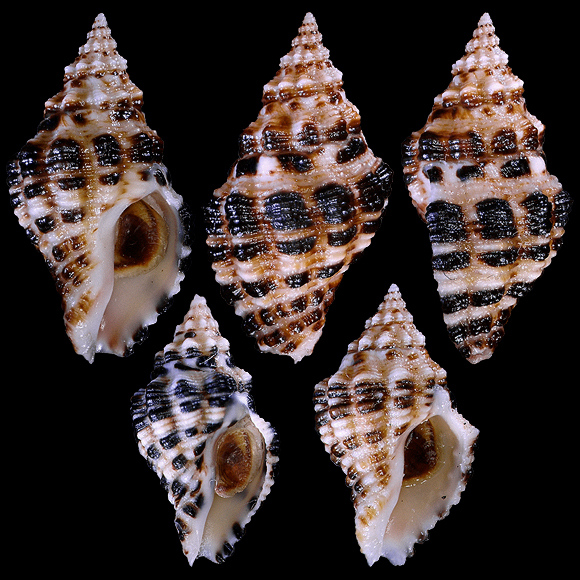
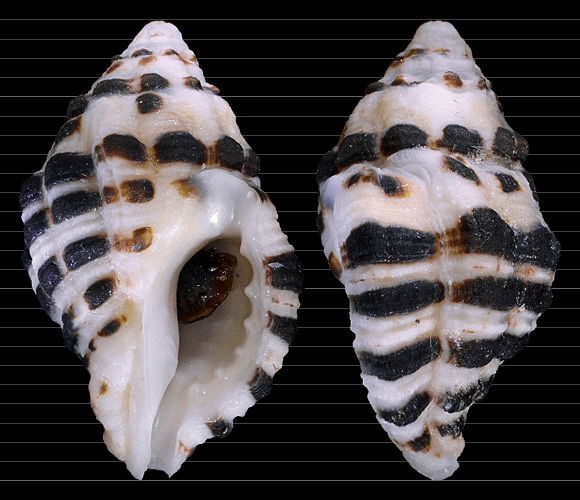
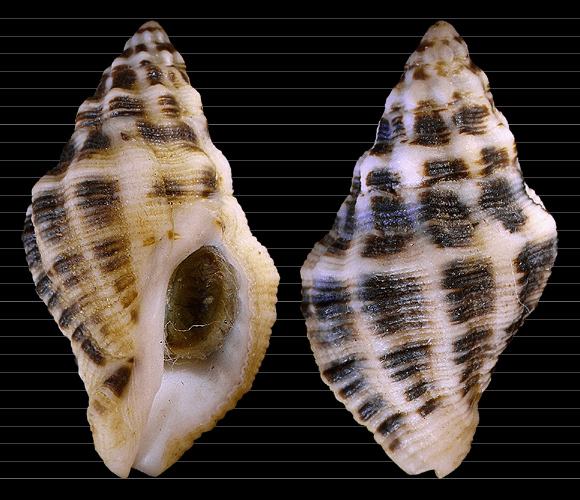
Labelled “heptagonalis”, this specimen was collected at 0,2-0,5m below the surface, at extreme low tide, on mooring pillar, Katembe settlement, right bank of the Estuário, Maputo, S. Mozambique. 25,8mm. We are out of the range of junionae, and heptagonalis is the only close taxon available in the area.
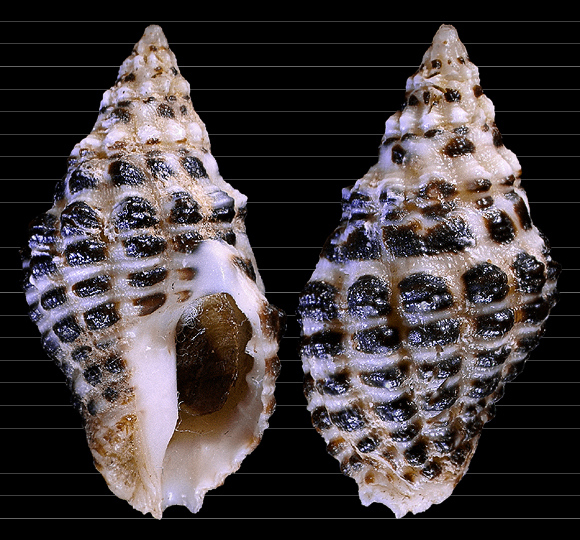
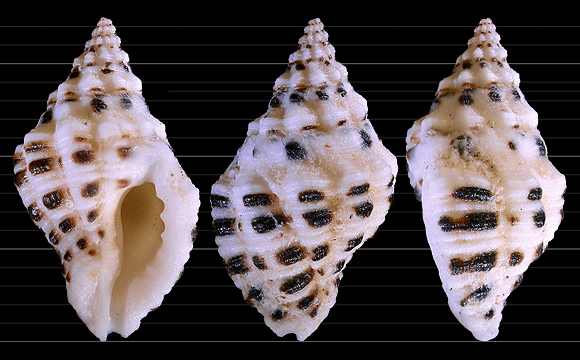
A difference with heptagonalis is given by the number and the strength of the labial inner denticles: they are fewer and stronger in junionae. Above, a specimen collected at 50cm deep, on stone, on the breakwater of Al Hamryia fish harbour, beach side, Sharjah emirate, north of Dubai, UAE. 21,8mm.