Basionym: Bulla orbignyana.
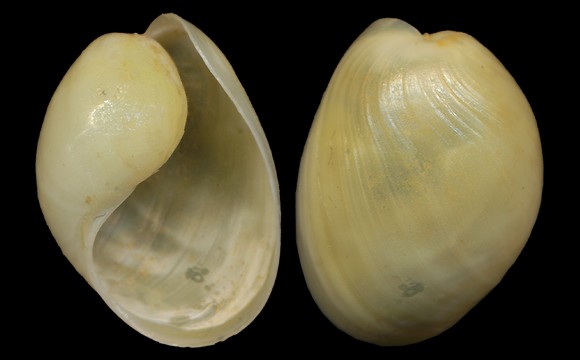
The shell is devoid of any spiral sculpture, and only bears some longitudinal growth marks; the aperture is broad anteriorly, narrow posteriorly; labial margin « slightly larger than the spire, which is involute » (Malaquias & Cervera, 2006). « Columella covered by thin callus ».
Sant’Antioco island, Carbonia-Iglesias, SW. Sardinia. 10mm.
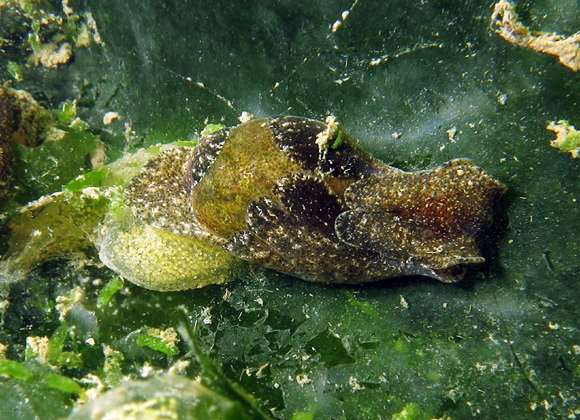
« The background body color is variable, generally light fawn in young specimens and greenish in the adult ones. Orange and brown spots are disseminated all over the body and there are white spots in the palial lobe. The upper edges of the parapodial lobes and the lateral edges of the cephalic shield are pigmented with a dark green-brown color. There is also a triangular area of this color from the eyes to the anterior edge of the cephalic shield… » – Talavera, Murillo & Templado: “The genus Haminoea Turton & Kingston, 1830 (Opisthobranchia, Bullomorpha) in the south east of Spain with the description of a new species”, Bollettino Malacologico vol. 23(1-4), Milano 1987, p.58.
Specimen laying eggs on some sea lettuce at the Pialassa Baiona, an eutrophic coastal lagoon connected to the Adriatic Sea through the channel-port of Ravenna, Italy. Notice the dark colour of the parapodial lobes. Original picture provided by M. Ponti for iNaturalist.org – (CC BY-NC).
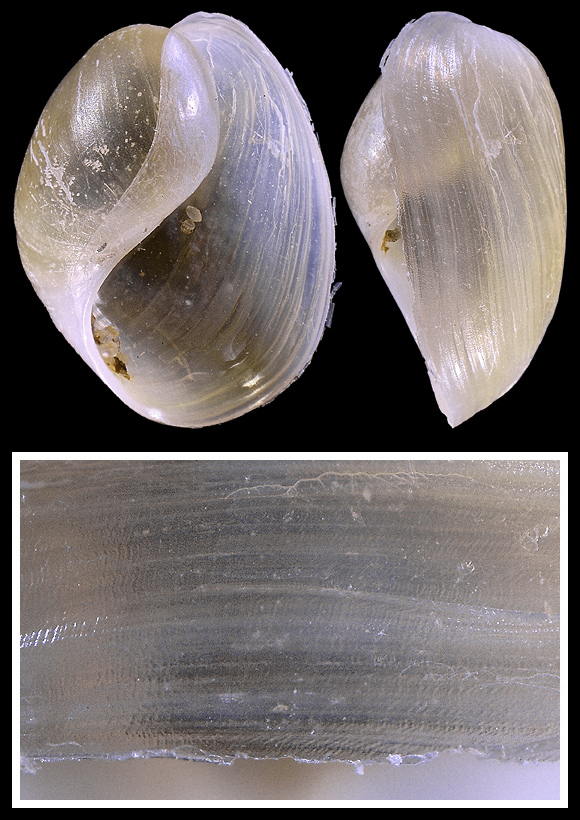
On sand at 2m deep, Málaga, Andalucia, S. Spain. 7,5mm.
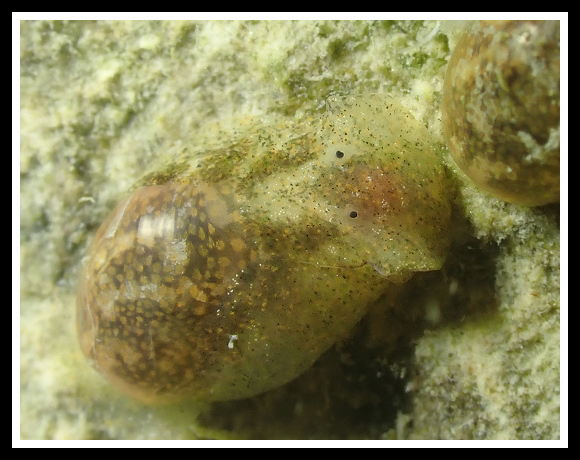

Original picture provided by P. Corbrion for iNaturalist.
– (CC BY-NC-SA) –