(Dautzenberg, 1881)
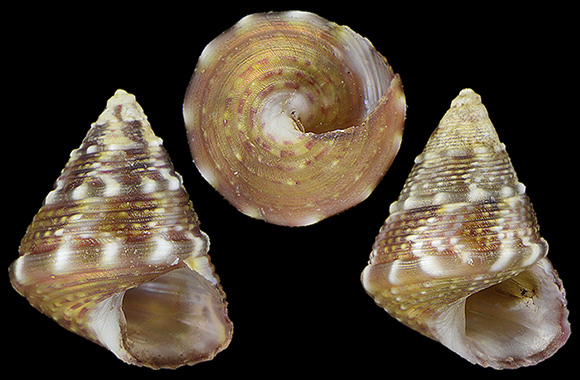
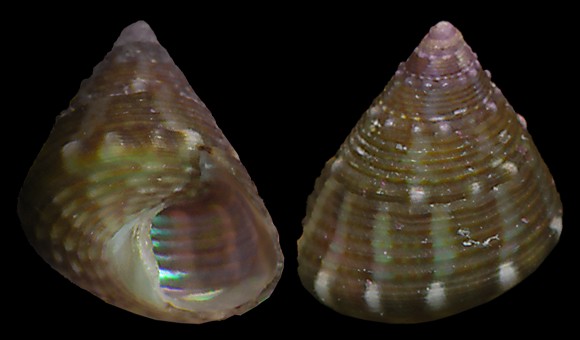
Portugal to Dakar area, western Mediterranean east to Adriatic. Grazer and deposit feeder in the shallow infralittoral. Basionym: Trochus gravinae. Synonyms: laeviusculus, parvosiculus. The shell of this species bears a strongly striated peripheral bead. It differs from that of karpathoensis by the more regular pattern of alternatively pale and brownsih small dots on the spiral cords; in gravinae these dots are of equal sizes, while the brownish-reddish dots are much more lengthened in karpathoensis.
Shallow water, Livorno, Toscana, W. Italy. 5-6mm.
Source: gruppomalacologicoscalaria.org.
Original pictures provided by A. Nappo (IT).
– (CC BY-NC-SA) –
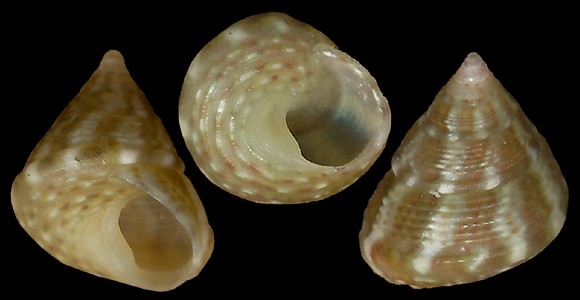
Shell of medium size for the genus. The whorls are flat, the shape conical. Protoconch, of about 1 whorl, sculptured by one spiral thread. « Teleoconch of 4.5-6.0 slightly convex whorls. Sculpture of 4-5 flat, closely set abapical spiral cords of about the same strength, a rippled peripheral cord formed by 4-5 merged cordlets, and 6-7 regularly spaced, basal flat spiral cords. Suture incised. Teleoconch surface covered by barely visible prosocline growth striae, irregularly set. Base convex, umbilicus closed also in juveniles, covered with a white callus. Aperture quadrangular, with the columellar callus thickened in the middle portion. Interior of the aperture whitish or pinkish nacreous. » – Mariottini & al.: “Integrative taxonomy of northeastern Atlantic top-shells of the genus Jujubinus Monterosato, 1884 (Gastropoda, Trochidae, Cantharidinae)”, European Journal of Taxonomy vol. 1044, march 2026, p.33.
On stones among algae, Ghjunchitu bay, Isola Rossa, NW. Corsica. 6mm.
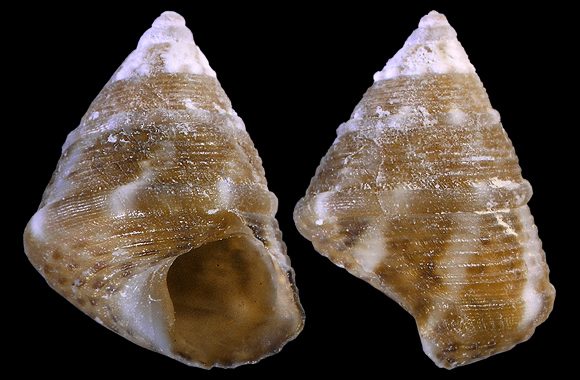
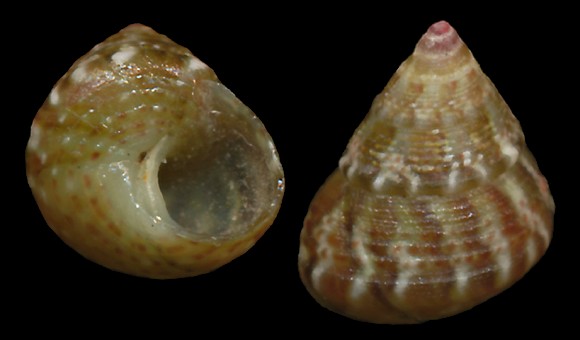
« …similar in the general aspect, [it] can be easily diagnosed by the complete lack of tubercles on the peripheral cord and for the different colouration, bright greenish cream or greenish whitish, with alternating whitish or reddish or blackish spots on the peripheral cord vs cream or whitish background, with brownish-reddish flammules of J. gravinae. » – Op.cit. p.34.
Above: 5m deep, under rock, Los Organos, San Andrés, NE. Tenerife, Canarias. 4mm.