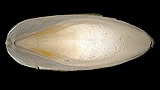
« The long, oval body is flattened dorsoventrally and bordered all along by narrow fins that do not connect at the posterior end. The internal shell (i.e. sepion or cuttlebone) lies dorsally in the body beneath the skin. The shell is a thick, oval, lanceolate or rhomboidal calcareous structure containing numerous gas and/or water filled chambers. The shell enables buoyancy control (Denton and Gilpin-Brown, 1973; Denton, 1974; see Mangold and Bidder, 1989). The eye lenses are covered by a protective cornea. The ventral arms are generally the longest and broadest; the left ventral is hectocotylized in males. The arms bear suckers in 2 to 4 series. The tentacles are completely retractile into pockets. » – CephBase (CC BY-NC).
Rhombosepium Rochebrune, 1884:
« Sepion narrow, thin, diamond-shaped, with a weakly convex dorsal face, not very rough, with a broad middle rib circumscribed by two shallow furrows; ventral face sub-concave, mediocrely convex in the upper region, with a posterior end narrower than the anterior, edges lined by a chitinous membrane, wide only in the last lower half, and narrowing at the obtuse tip, slightly curved and simulating a beak not very hooked, narrow, inclined inwards, and more or less developed. » – A. T. de Rochebrune: “Étude monographique de la famille des Sepiadae”, Bulletin de la Société philomathique de Paris series VII vol.VIII, Paris 1884, p.82.
Sepia Linnaeus, 1758:
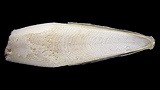
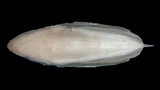
« Sepion long, ovoid, subacute or rounded at the apex, widened and rounded at the back; dorsal surface more or less rough, almost always smooth in a certain space in the vicinity of the lower extremity, the latter carrying a more or less prominent tubercle not exceeding never the free edge. » – A. T. de Rochebrune: “Étude monographique de la famille des Sepiadae”, Bulletin de la Société philomathique de Paris series VII vol.VIII, Paris 1884, p.114.