Giribet & Peñas, 1999
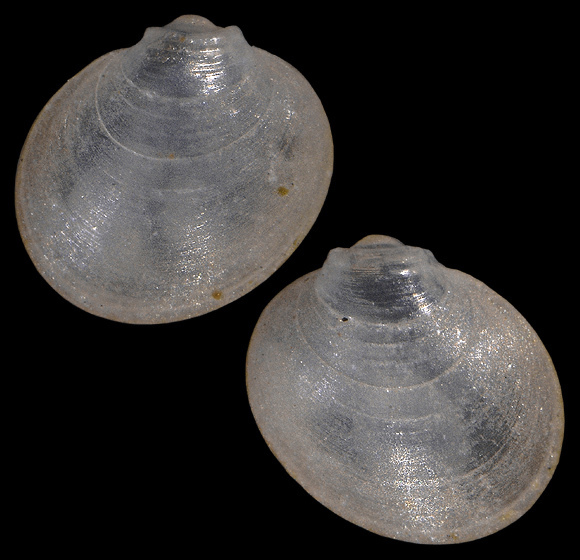
Commensal with unknown burrowing creatures on sedimentary bottoms of the infralittoral, the circalittoral and the continental shelf (white coral biocenosis). Single valves found also deeper. Protonym: Epilepton parussetensis.
« Shell small (from 0.78 to 1.40mm long), translucent, thin and fragile, equivalve; inequilateral, beaks in the posterior half, directed inwards; pale yellow color in fresh shells, or white in old shells. Prodissoconch small, pointed at the tip, with a well differentiated ridge surrounding the apex […]; surface smooth with fine concentric lines. […] Growth stages clear, lacking radiating lines. Right valve with one cardinal tooth subcentrally […] and single anterior and posterior lateral teeth on a narrow hinge plate […]. Left valve with single anterior and posterior lateral teeth on a narrow hinge plate, and a notch for the cardinal tooth. Adductor muscle scars indistinct. Pallial line indistinct, without sinus. Internal margin smooth. » – Giribet & Peñas: “A new Epilepton species (Bivalvia, Montacutidae) from the Western Mediterranean”, Iberus vol. 16(2), Barcelona 1999, p.118. Above and below: fresh specimen collected at 45m deep, Scilla, Calabria, S. Italy. 1mm. Nota bene that entire specimens were found also in Scilla cave at 52m deep. The ridge that borders the margin of the prodissoconch is specific.
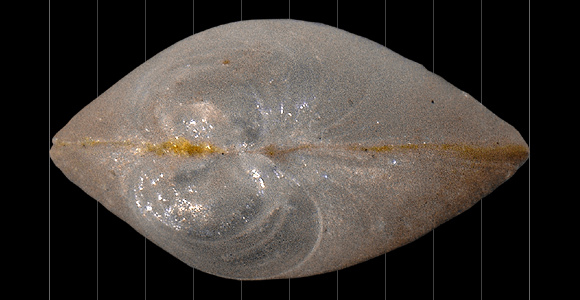
« The new species is easily distinguishable from Epilepton clarkiae (Clark W., 1852), because its smaller size, more rounded and less flattened than E. clarkiae (see a S.E.M. picture in VAN AARTSEN ET AL., 1984, Fig. 330). Furthermore E. parrussetensis lacks radiating lines, but growth lines are more evident than in E. clarkiae. The prodissoconch of both species differ in shape and in the ridge only present at E. parrussetensis, making both species unmistakable. » – Op. cit. p.118-119.