Fossil in the Miocene up to the recent Quaternary. Some beach refreshment at Alcúdia and Can Picafort, Mallorca, Illes Balears, provided some fresh specimens that look like inflata. This find suggest that the species could be still extant. The area where the sand came from, Banyalbufar (on the western coast), is known as a very peculiar marine habitat; « si fuera tierra firme, sería declarado monumento natural. » – C. Ruiz Altaba, the discoverer, to Ultima Hora, may 2002.
« The shape of this shell is more swollen than all the previous ones and is very close to the orbicular form; however, on the upper edge of the right side, one can distinguish in some individuals a depression – light, certainly, but sufficient to significantly reduce the width of the valves on this side – which gives them an irregular ovoid shape. » – G. B. Brocchi: Conchiologia fossile subapennina vol. II, Milano 1814, p.494.
« The shape of this shell is more swollen than all the previous ones and is very close to the orbicular form; however, on the upper edge of the right side, one can distinguish in some individuals a depression – light, certainly, but sufficient to significantly reduce the width of the valves on this side – which gives them an irregular ovoid shape. » – G. B. Brocchi: Conchiologia fossile subapennina vol. II, Milano 1814, p.494.
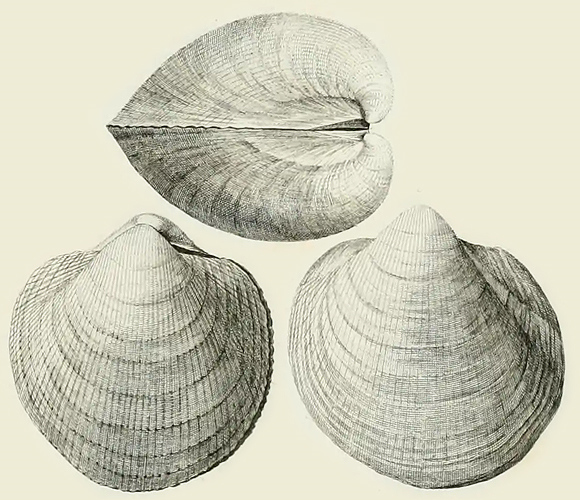
Above: the species in Brocchi, plate XI fig.7.
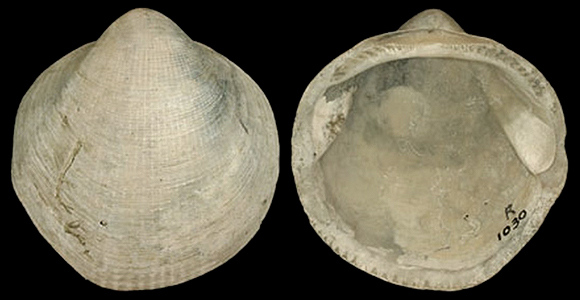
« The vertices are protruding and without any obliquity; on both sides, the edge of the two valves rises up like the “ears” of the Pectens. The ligamentary area is narrower and shorter than in the previous species [Arca insubrica], and the hinge is provided with teeth along its entire length. On the anterior side of the shell, there is a cordiform space, smoother than the rest, but without the marked imprint found in Arca insubrica. » – Op. cit. p.494-495. Above: right valve collected near Piacenza, Emilia-Romagna, Italy. 54mm. Specimen NMR993000078879 in the collection of the Natural History Museum Rotterdam. Original pictures provided by J. Trausel & F. Slieker for the NHMR – (CC BY), accessed by GBIF.ofg.
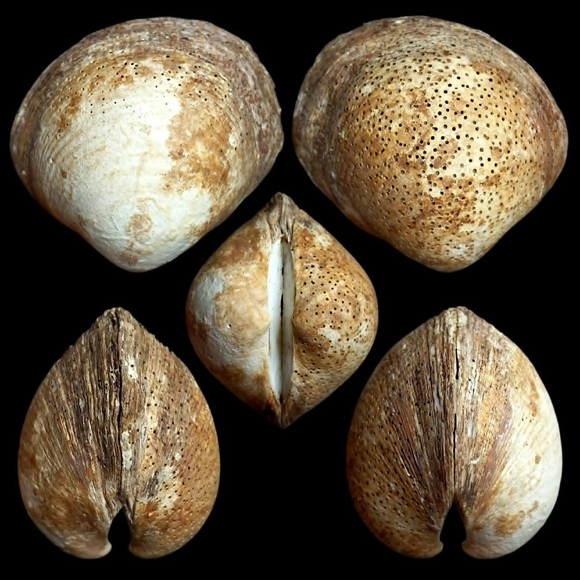
Original pictures provided by J. Juárez Ruiz (ES).
– (CC BY-NC-SA) –
The possible rediscovery of Glycymeris inflata was not only the result of finds at sea or on the beach. One of the most curious events in this story took place in the room occupied by the famous Doctor illuminatus Ramón LLull, in Miramar monastery, Valldemossa, Mallorca: a few portraits hung in the room were lined with valves of Glycymeris. Some were missing but, fortunately, had been kept « un capazo de las conchas usadas y hechas recoger por el Archiduque Luis Salvador en 1872, propietario entonces del predio. Examinado el conjunto de ellas, se halló cuatro, cuyas características conquiológicas coinciden con Glycymeris inflata. » – Cifre, Forés & Canyelles: “Glycymeris inflata, especie viviente y no fósil. Nuevos datos”, Scripta Musei Geologici Seminarii Barcinonensis [Ser. malacologica] IV, Barcelona 2021, p.4. Also, possible presence of inflata in Turkey (Ibid.)
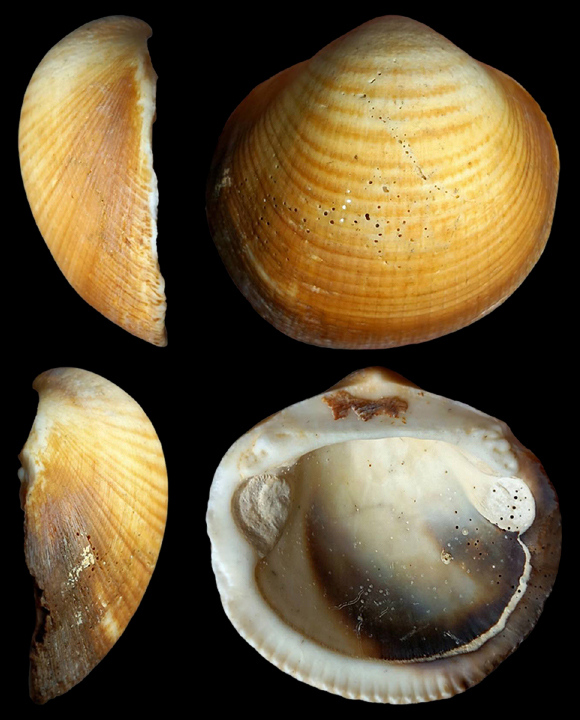
The shell is often large, like in bimaculata or nummaria but is more globose. Above, beachstormed valve, Playa Ciudad Jardín, Palma Bay. 114mm x 18mm. Original pictures provided by J. Juárez Ruiz (ES) – (CC BY-NC-SA).