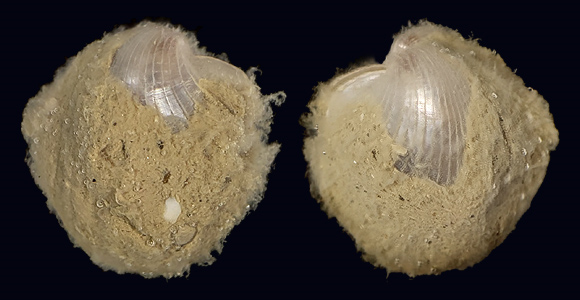
Low circalittoral, continental plate and slope.
Basionym: Lyonsia gemma.
Synonym: insculpta Seguenza.
« Shell small, iridescent, white, with raised radii, broad-oval, widest and broadly rounded anteriorly, expanded and broadly rounded ventrally, posterior end short, narrowed, and tapered to an obtuse point. The beak is subcentral, but a little nearer the anterior end, prominent, inflated, strongly curved inward and forward. Dorsal margin abruptly incurved opposite the beaks and decidedly expanded and excurved in front of them, so as to rise nearly to a level with the umbos; internally, opposite the tips of the beaks, there is a smooth swelling within the margin. Hinge margin thin, toothless, but with an internal scar behind the beaks, where the ligament and ossicle were attached (the ligament is gone). Palial sinus very small, angular. » – A. E. Verrill: “Notice of recent addition to the marine Invertebrata of the northeastern coast of America, with descriptions of new genera and species and critical remarks on others” part II, Proceedings of the United States National Museum vol. III, Washington 1880, p.396.
Above and below: 95 m deep, on muddy bioclastic grit, Cap d’Agde, Hérault, S. France. 8mm.
Original pictures provided by B. Cunningham Aparicio (ES).
– CC BY-NC-SA) –
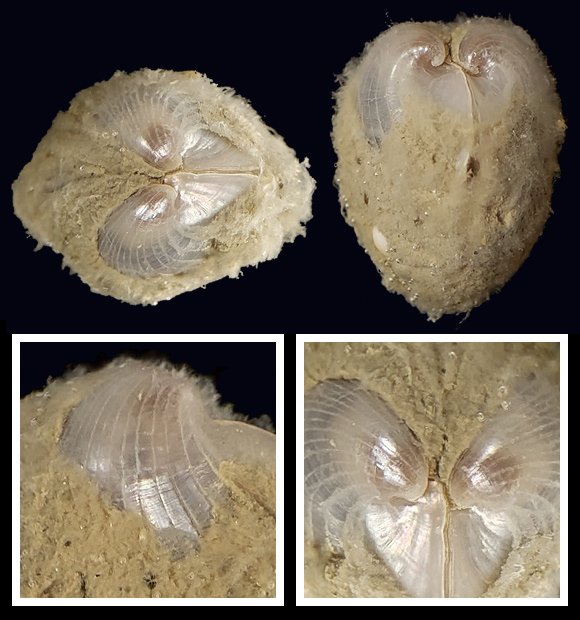
« Sculpture: numerous, very delicate, slightly raised lines, which radiate from the beaks over the whole surface; they are separated by much wider interspaces, which are smooth and iridescent, and not at all excavated. » – Op. cit. p.397.
Some growth line appear also.