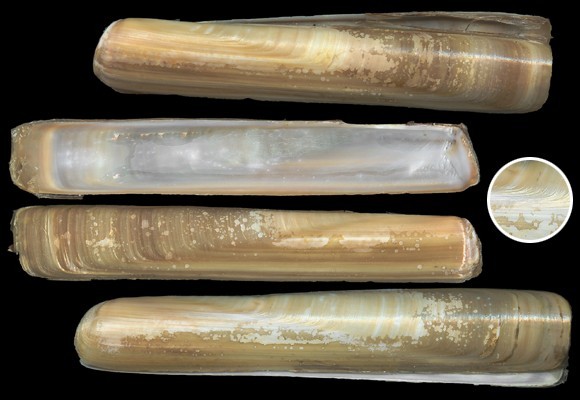
Synonyms: gladius, rotundatus, and vagina Pennant.
Shallow water in sand, Grado, Friuli Venezia Giulia, NE. Italy. 104-107mm. L.D. Kellner legit (DE).

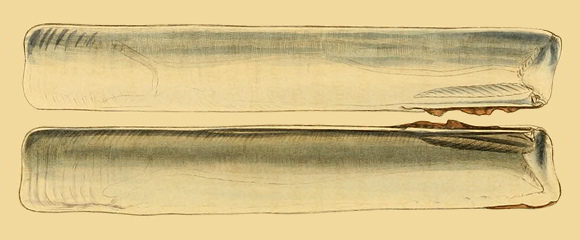
« Shell straight, linear, each valve with one tooth; the hinge end with a large transverse furrow, and a broad margin. Colour of the shell, cinereous, or yellowish-brown. Probably a variety only of the European S. vagina, from which it seems to differ only in the width of the margin, at the extremity. I suspect it to be the shell described by Mr. Pennant as the S. vagina. Very rare. Dredged up at Weymouth. » – R. Pulteney: Catalogue of the birds, shells, and some of the more rare plants of Dorsetshire, London 1799, p.28.
Above: profile of Richard Pulteney (1730-1801), physician, botanist and conchologist, drawn circa 1799 by Thomas Rackett, clergyman, who himself became conchologist.
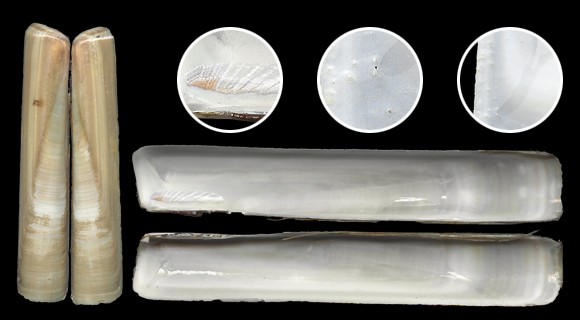
and the sand grains captured near the pallial sinus (right). Grado, 57-108mm.
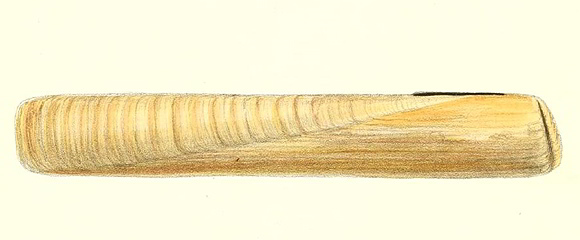
« The bordered Solen. Shell rather narrow, convex, fulvous ; epidermis thin ; dorsal margin straight, dorsal area linear, inconspicuous ; umbonal area broad, rather rough ; ventral margin very slightly excavated in the middle ; anterior margin oblique, raised, single-ribbed, constricted behind the rib by a deep canal. »
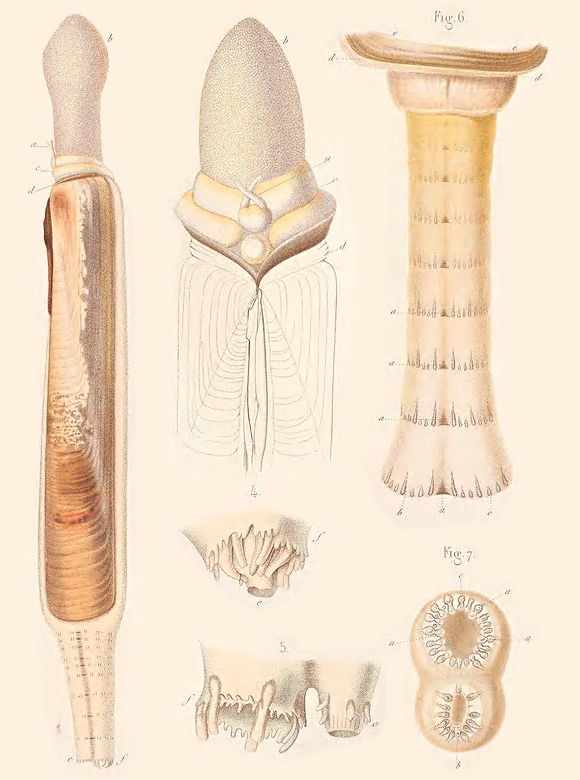
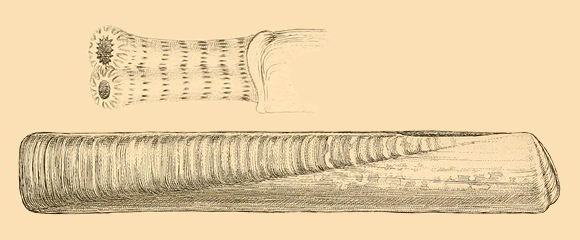
Figures 4 & 5: e = anal siphon, f = branchial siphon. Like in the Solecurtidae, these organs are composed of numerous segments that can be successively left in case of predator attacks. Figure 7 shows a front-view of such injured siphons, and fig. 6 displays a top-view of the same: notice the absence of the tentacles, gone with the final segment during an attack.